
Nobody Tells You Healing Isn’t Linear (Here’s What It Actually Looks Like)
Healing isn’t a straight line up. Discover why setbacks don’t mean failure, and how to keep going even on the hard days.
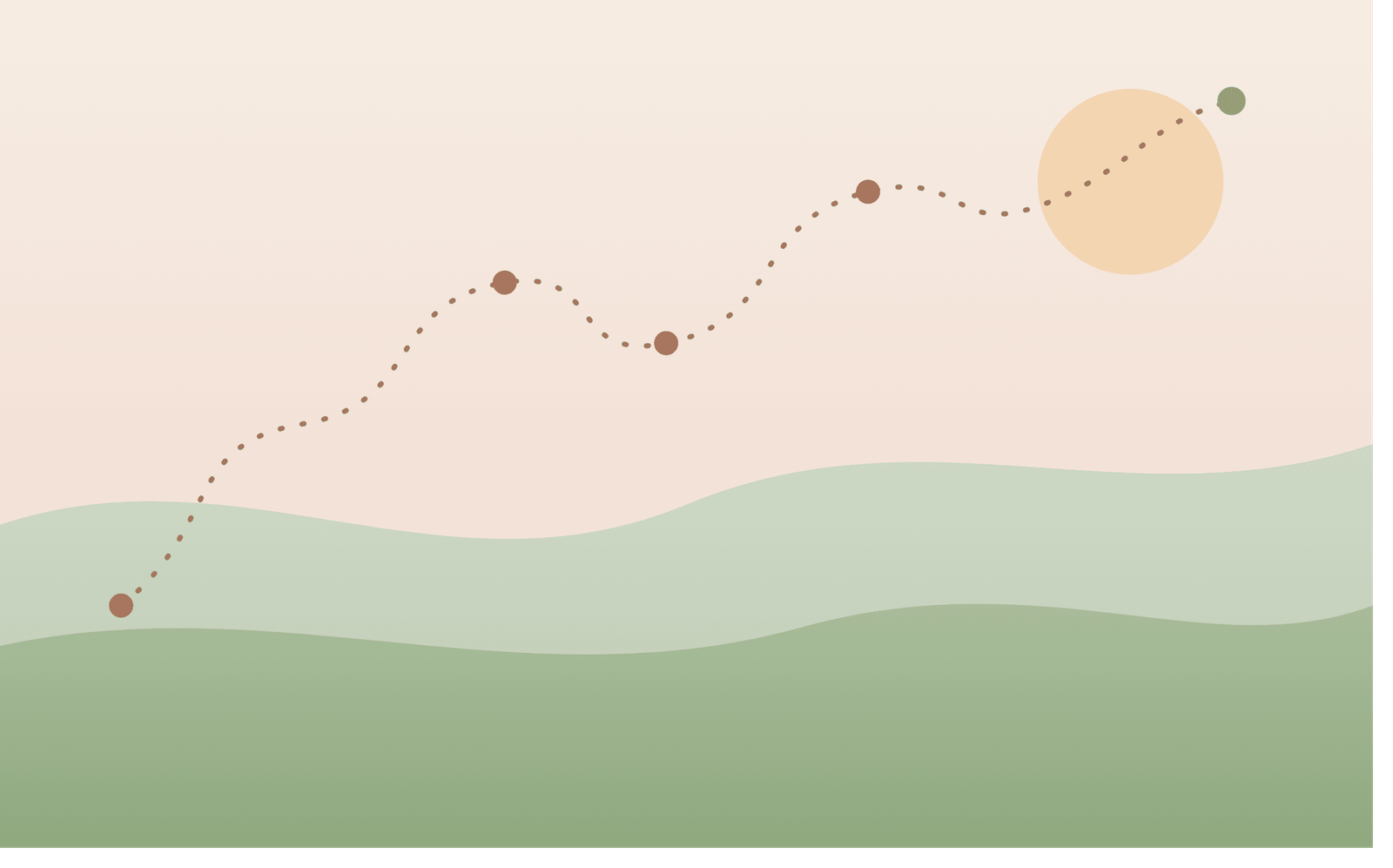
There’s a version of healing we’re sold everywhere — a clean upward line. You hit rock bottom, you start “working on yourself,” and from there it’s steady, visible progress until one day you’re fixed. Nobody tells you healing is not linear. No-one warns you it doesn’t actually work that way.
The Day You Feel Unstoppable
Some days, you feel like a completely different person. You journal, you go for a walk, you say NO to something that used to scare you. You think, finally, I’ve figured this out.
And then, without warning, a random Tuesday undoes all of it. A comment, a memory, a bad night’s sleep — and suddenly you’re right back where you started. The anxiety is loud again. The old habits feel tempting again. The progress feels erased.
If you’ve been here, you already know the question that follows: did I actually get better at all?
Why Healing isn’t a Straight Line? (The Psychology Behind It)
There’s a reason setbacks feel like betrayal — we picture healing as a staircase, each step higher than the last. But that’s not how the brain, or grief, or growth actually works.
Emotional change is closer to strengthening a muscle than flipping a switch. Every time you practice a new response — staying calm instead of spiraling, setting a boundary instead of over-explaining — you’re building a new neural pathway. But old pathways don’t disappear overnight. Under stress, fatigue, or a strong trigger, the brain often defaults back to the old, more familiar pattern, simply because it’s had more repetitions.
That’s not your willpower failing. That’s how learning works, for anyone, in any domain. Athletes have off days. Musicians have days their fingers won’t cooperate. It doesn’t mean the training didn’t work — it means the process is not, and was never going to be, a smooth incline.
Add to that the fact that healing often happens in layers. You resolve one issue and, underneath it, find another that was hidden. A hard day doesn’t always mean you’ve regressed — sometimes it means you’ve gone deep enough to reach the next layer.
What This Looks Like in Real Life
Grief
You laugh at a memory of someone you lost and feel lighter for the first time in weeks — and then a song on the radio undoes you in the grocery store. Both moments are part of grieving. Neither cancels the other out.
Anxiety recovery
You go a whole month without a panic attack, start to trust your progress, and then one shows up out of nowhere before a big meeting. That doesn’t erase the month. It means your nervous system is still learning, not that it forgot everything.
Rebuilding after a breakup or betrayal
You feel confident and whole for weeks, then a small thing — a name, a place, a familiar smell — pulls you right back into the ache. That’s not a step backward in the relationship you have with yourself. It’s just proof that healing touches the same wound from different angles over time.
In every case, the pattern is the same: progress, dip, progress again — not because the dip erased the progress, but because the dip is part of the progress.
That’s Not Failure — That’s the Process
Here’s the part almost nobody says out loud: a hard day doesn’t cancel out your progress. It doesn’t mean you’re “back to square one.” It doesn’t mean the work you did wasn’t real.
Healing was never supposed to be a straight line. It’s closer to weather than to a staircase — better seasons, harder seasons, and a general direction over time that’s easier to see in hindsight than in the moment you’re living it.
The bad days aren’t proof you failed. They’re proof you’re human, in a process that was never designed to be tidy.
What Actually Changes is Your Relationship to the Bad Days
The goal was never to stop having hard days entirely. The real shift — the one that’s easy to miss because it’s quiet — is in how you respond to them.
Early on, a hard day might spiral into a hard week. Later, it becomes something you can name, sit with, and move through faster. You still stumble. You just don’t stay down as long. You still feel triggered. You just know, now, that it will pass.
That’s not the absence of struggle. That’s growth wearing a disguise.
What to Actually Do on a Hard Day?
Reassurance helps, but it’s easier to get through a setback with something concrete to do. Next time a hard day hits:
- Name it without judging it – Simply say to yourself, “this is a hard day, not a hard life.” Naming the feeling — instead of arguing with it — lowers its intensity almost immediately.
- Check the basics first – Sleep, food, movement, and social contact affect emotional resilience more than most people realize. A setback after a bad night’s sleep is often biology, not a character flaw.
- Do one small thing you know helps – a walk, a shower, texting one person, stepping outside for five minutes. The goal isn’t to fix the whole day, just to interrupt the spiral.
- Look back, not just forward – Compare today to six months ago, not to yesterday’s good day. Healing is measured in seasons, not single days.
- Let it be temporary – You don’t have to solve the hard day. You just have to get through it. Most hard days pass faster than they feel like they will in the middle of them.
- Learn to make a balance – One minute you’re fine, the next you’re crying in the supermarket. There is an overall balance of which you do more, and healing is in the changing of that balance, not in any individual episode of tears or smiling. So learn to make a balance.
- Zoom Out – When zooming in on a specific moment it can feel like you are only going down. But when you zoom out you could notice that the line in general is going up; you’re healing. Try to look at it in the broader picture. Time heals every wound. You are doing great, keep up the good work and keep focusing on the parts of you that have grown and healed. The other parts will follow.
If Today is One of the Hard Days
If you’re reading this on a day that undid your progress, here’s what’s worth remembering:
- You are not starting over – Setbacks are part of the terrain, not a detour off it.
- This feeling is information, not a verdict – It’s telling you something needs attention — not that you’ve failed.
- Progress you can’t feel today is still progress – You’ve survived every hard day so far. That track record counts for something, even when it doesn’t feel like it.
Frequently Asked Questions
Is it normal to feel worse before you feel better?
Yes. As old coping mechanisms fall away, the emotions they were masking often surface for the first time. This can feel like regression, but it’s frequently a sign that deeper healing is happening, not that something has gone wrong.
How do I know if I’m actually making progress?
Look for changes in duration and recovery, not the absence of hard days. If your hard days are shorter, your recovery is faster, or you’re handling them with more self-compassion than before — that’s progress, even if the hard days themselves haven’t disappeared.
When should a setback be taken seriously, rather than seen as “part of healing”?
If setbacks are getting more frequent, more intense, or are accompanied by thoughts of self-harm, that’s a sign to reach out to a mental health professional rather than waiting it out alone. Normal ups and downs generally trend gently upward over months; a pattern that keeps getting worse deserves support, not just patience.
The Takeaway
Healing was never about becoming a person who never struggles again. It’s about becoming someone who knows how to come back — a little steadier, a little faster, every time.
The line isn’t straight. It was never supposed to be.
Save this for the next time you need reminding that the hard days don’t undo the work.