
Why So Many People Feel Stuck in Life & How to Move Forward?
Feeling stuck in life can be confusing and exhausting. Discover the deeper psychological reasons behind it and how small internal shifts create real forward motion.
The Quiet Weight of Standing Still
Feeling stuck in life does not usually arrive as a crisis.
There is no dramatic collapse, no obvious failure, no single moment where everything falls apart.
Instead, it arrives quietly.
It lives in repeated days that feel strangely similar.
In conversations that no longer excite you.
In the growing sense that you are capable of more — yet unable to access it.
Many people assume that feeling stuck means something is wrong with them. That they lack discipline, ambition, courage, or clarity. But that assumption itself is part of the problem.
Feeling stuck is not a flaw.
It is a transition state.
Understanding what this state really means — and how to move through it — requires looking deeper than motivation or productivity advice.
What “Feeling Stuck in Life” Really Means
When people say they feel stuck, they often mean different things:
- “I don’t know what I want anymore.”
- “I’m doing everything I’m supposed to, but it feels empty.”
- “I want change, but I don’t know where to start.”
- “I feel behind in life compared to others.”
At its core, feeling stuck in life is not about lack of movement.
Most people who feel stuck are actually very busy.
It is about movement without meaning.
You are moving, but not in a direction that feels internally aligned. Over time, this creates emotional friction — the kind that drains energy without producing visible failure.
The Misleading Advice That Keeps People Stuck
The internet is full of advice for people who feel stuck:
- “Just take action.”
- “Set bigger goals.”
- “Work harder.”
- “Be more disciplined.”
- “Stay positive.”
While well-intentioned, this advice assumes the problem is external behavior.
In reality, the deeper issue is internal resistance.
When action feels forced, it’s usually because the mind is trying to protect an identity that no longer fits.
The Role of Identity in Feeling Stuck
Every phase of life has an identity attached to it.
At some point, the identity that once helped you survive or succeed becomes outdated. But the mind does not let go easily.
You may still see yourself as:
- “The responsible one”
- “The safe one”
- “The one who doesn’t take risks”
- “The one who keeps everyone comfortable”
- “The version of me that people expect”
As long as you remain loyal to an outdated identity, growth feels threatening — even when it’s desired.
This is why people can want change and resist it at the same time.
Comfort Is Often the Most Dangerous Trap
Comfort rarely feels like a trap while you’re inside it.
It feels reasonable.
It feels logical.
It feels safe.
But comfort without growth slowly turns into stagnation.
The danger is not that comfort makes you lazy.
The danger is that it makes you emotionally numb.
You stop asking difficult questions because your life “works.”
You stop listening to discomfort because it’s inconvenient.
You stop imagining alternatives because they feel unrealistic.
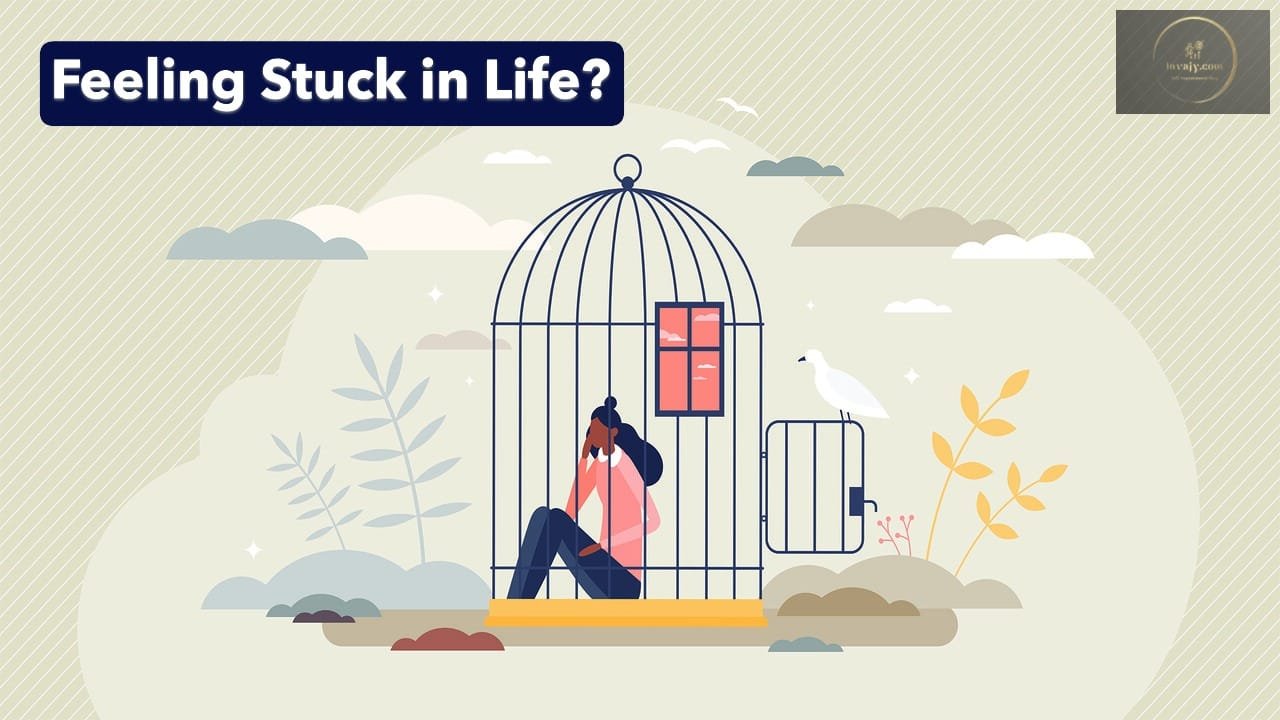
Eventually, comfort becomes a cage you can’t see.
Why Comparison Intensifies Feeling Stuck
Social comparison does not create feeling stuck — it amplifies it.
When you compare your inner confusion to someone else’s curated certainty, your discomfort turns into self-judgment.
You begin to believe:
- “Everyone else has figured it out.”
- “I’m falling behind.”
- “I should be further along.”
But comparison skips an important truth:
You are comparing your internal process to someone else’s external presentation.
This mismatch creates unnecessary pressure and distracts you from your own path.
The Psychological Reason Clarity Feels So Hard
Clarity is often treated as a prerequisite for action.
People say:
“Once I’m clear, I’ll move.”
In reality, clarity is usually the result of movement — not the cause.
The mind wants certainty before risk.
Life offers clarity after engagement.
This creates a paradox:
- You wait for clarity to act
- Clarity waits for you to act
Staying stuck is often the mind’s way of avoiding uncertainty, not laziness.
Emotional Avoidance Disguised as Overthinking
Overthinking is rarely about thinking too much.
It is about feeling too little.
When you avoid emotions like fear, grief, disappointment, or regret, the mind stays busy analyzing instead of experiencing.
This creates a loop:
- Thinking replaces feeling
- Planning replaces experimenting
- Imagining replaces living
Breaking this loop requires emotional honesty, not better planning.
The Subtle Fear Beneath Feeling Stuck
If you listen carefully, feeling stuck often carries a quiet fear:
“What if I change and lose something important?”
You may fear losing:
- Stability
- Approval
- Relationships
- Familiarity
- A version of yourself that once felt useful
Growth always requires loss — not necessarily of people or security, but of outdated self-definitions.
The mind resists this loss even when the soul is ready to move on.
Why Small Changes Matter More Than Big Decisions
People who feel stuck often believe they need a dramatic breakthrough:
- A new career
- A new city
- A new relationship
- A completely new life
But big decisions are intimidating because they feel irreversible.
Small changes are powerful because they are repeatable.
Examples:
- Speaking honestly when you usually stay quiet
- Saying no when you usually say yes
- Choosing curiosity over certainty
- Allowing discomfort without fixing it
These shifts slowly retrain identity — and identity drives behavior.
A Daily Practice to Create Forward Motion
Once per day, ask yourself:
“What am I doing today that reinforces an identity I’ve outgrown?”
Do not try to correct it immediately.
Awareness loosens attachment.
Attachment loosens resistance.
Resistance loosens stagnation.
Progress begins internally long before it becomes visible externally.
Why Feeling Lost Is a Sign of Expansion
Feeling lost is uncomfortable because it removes familiar reference points.
But loss of direction often means your old direction no longer fits.
Before growth, there is confusion.
Before transformation, there is disorientation.
Before alignment, there is questioning.
Trying to eliminate this phase only delays the process.
Reframing the Idea of Purpose
Purpose is often imagined as a single destination.
In reality, purpose is a relationship with curiosity.
It evolves as you evolve.
You don’t find purpose by thinking harder.
You find it by engaging more honestly with life.
Purpose becomes clearer when you allow yourself to change.
The Quiet Confidence That Comes From Movement
Real confidence does not come from certainty.
It comes from evidence.
Each small act of honesty, courage, or experimentation builds trust with yourself.
Over time, this trust replaces the fear that kept you stuck.
You stop asking:
“What if I fail?”
And start asking:
“What can I learn?”
Final Reflection
Feeling stuck in life is not a dead end.
It is a doorway.
It appears when your current way of living can no longer support your inner growth.
You don’t need to escape your life.
You need to listen to it more closely.
The moment you stop trying to fix the feeling — and start understanding it — movement begins.