
How to Discover Your Core Values (Step–by–Step)
Learn how to discover your core values step by step. Understand what truly matters to you and align your life with clarity, purpose, and self-awareness.
Why Core Values Matter More Than Goals?
Most people spend years chasing goals without ever asking a quieter, more important question:
“What actually matters to me?”
Goals change. Circumstances shift. Roles evolve.
But underneath every meaningful decision lies something more stable — your core values.
When your life aligns with your values, choices feel clearer, effort feels purposeful, and even challenges feel meaningful. When your life conflicts with them, confusion and dissatisfaction quietly grow — even if everything looks “successful” from the outside.
This article is not about adopting popular values or choosing words that sound impressive.
It is about discovering what already drives you, even when you’re not aware of it.
What Core Values Really Are (And What They Are Not)
Core values are often misunderstood.
They are not:
- Personality traits
- Moral slogans
- Aspirational words you wish described you
- Values you inherited but never questioned
Core values are the internal principles that consistently influence your decisions, emotions, and sense of rightness — especially under pressure.
They show up most clearly when:
- You feel deeply fulfilled
- You feel deeply conflicted
- You feel proud of yourself
- You feel resentment or regret
Values are revealed through lived experience, not theory.
Why Many People Feel Lost Without Knowing Their Values
When you don’t know your core values, life becomes reactive.
You say yes because it seems reasonable.
You pursue paths because they look successful.
You tolerate situations because you “should.”
Over time, this creates internal tension — not because you are weak or indecisive, but because your life is being guided by external expectations instead of internal clarity.
Discovering your values does not limit you.
It liberates your decision-making.
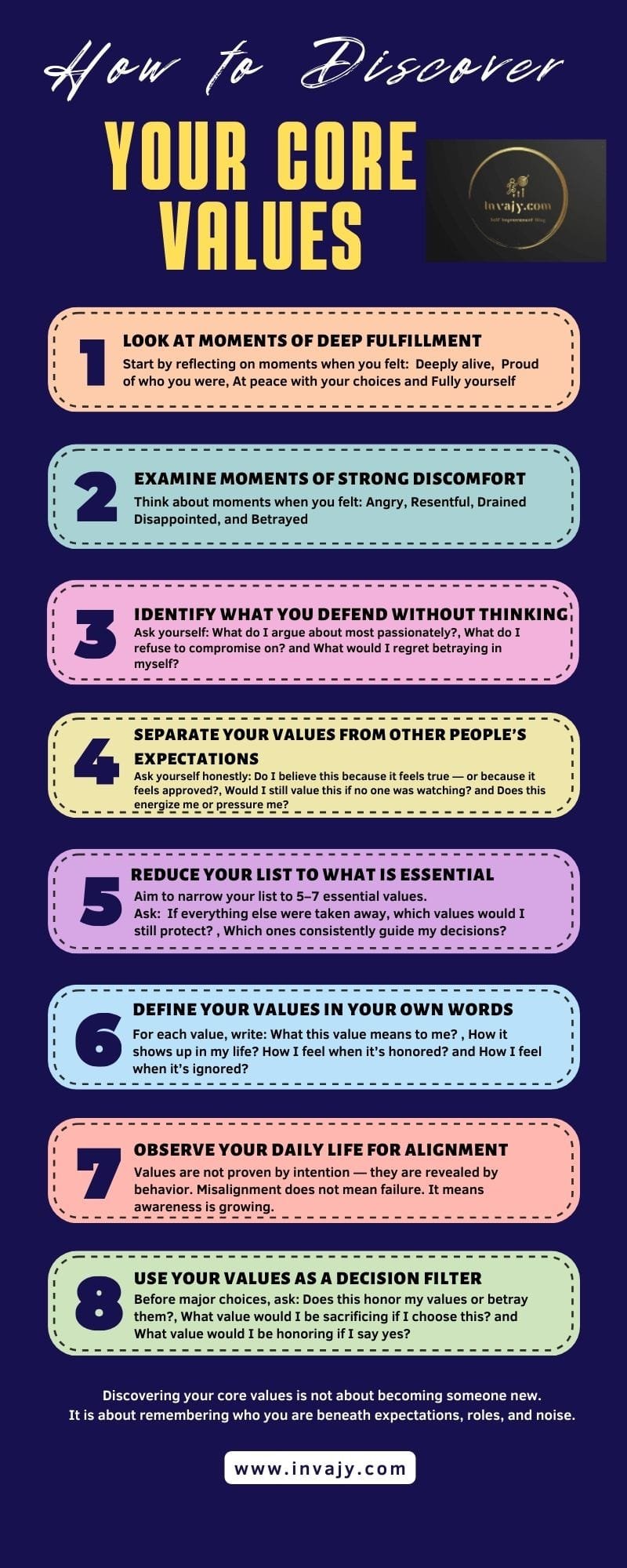
Step 1: Look at Moments of Deep Fulfillment
Your values are not hidden — they are encoded in your past.
Start by reflecting on moments when you felt:
- Deeply alive
- Proud of who you were
- At peace with your choices
- Fully yourself
Ask yourself:
- What was I doing?
- Who was I with?
- What made this moment meaningful?
Do not focus on achievements.
Focus on what felt right.
Patterns will begin to appear — connection, autonomy, creativity, honesty, contribution, learning, growth.
These patterns point directly to your values.
Step 2: Examine Moments of Strong Discomfort
Values reveal themselves just as clearly through pain.
Think about moments when you felt:
- Angry
- Resentful
- Drained
- Disappointed
- Betrayed
Ask:
- What exactly felt wrong?
- What boundary was crossed?
- What was missing?
For example:
If dishonesty triggers you → honesty is likely a core value
If feeling controlled drains you → autonomy may be essential
If superficiality frustrates you → depth or authenticity may matter deeply
Discomfort is often a signal of violated values, not just emotional sensitivity.
Step 3: Identify What You Defend Without Thinking
Notice what you instinctively protect or stand up for.
People defend their values even when it costs them comfort.
Ask yourself:
- What do I argue about most passionately?
- What do I refuse to compromise on?
- What would I regret betraying in myself?
Values show up in unconscious loyalty.
You may not always live by them perfectly — but you care when they are threatened.
Step 4: Separate Your Values from Other People’s Expectations
One of the hardest steps is distinguishing your values from those you inherited.
Many people unknowingly adopt values from:
- Family
- Culture
- Religion
- Society
- Social media
Ask yourself honestly:
- Do I believe this because it feels true — or because it feels approved?
- Would I still value this if no one was watching?
- Does this energize me or pressure me?
True values feel grounding, not performative.
Step 5: Reduce Your List to What Is Essential
You may resonate with many values — but core values are few.
Aim to narrow your list to 5–7 essential values.
Ask:
- If everything else were taken away, which values would I still protect?
- Which ones consistently guide my decisions?
- Which ones I feel most disconnected from when life feels wrong?
Core values are not about quantity.
They are about depth and consistency.
Step 6: Define Your Values in Your Own Words
Avoid dictionary definitions.
Two people can value “freedom” and mean completely different things.
For each value, write:
- What this value means to me?
- How it shows up in my life?
- How I feel when it’s honored?
- How I feel when it’s ignored?
For example:
Authenticity
→ Living in alignment with my inner truth, even when it’s uncomfortable
This step transforms values from abstract ideas into personal guides.
Step 7: Observe Your Daily Life for Alignment
Values are not proven by intention — they are revealed by behavior.
Ask:
- How do I spend my time?
- Where does my energy go?
- What do I prioritize when things get busy?
Misalignment does not mean failure.
It means awareness is growing.
Alignment is a practice, not a permanent state.
Step 8: Use Your Values as a Decision Filter
Once your values are clear, decision-making becomes simpler — not easier, but clearer.
Before major choices, ask:
- Does this honor my values or betray them?
- What value would I be sacrificing if I choose this?
- What value would I be honoring if I say yes?
Values do not guarantee comfort.
They guarantee self-respect.
Why Living by Your Values Feels Difficult at First?
Living by your values may initially feel uncomfortable because:
- It requires saying no
- It challenges old patterns
- It disrupts people-pleasing
- It exposes fears you avoided
But discomfort is often the price of alignment.
Over time, alignment creates:
- Inner calm
- Emotional consistency
- Stronger boundaries
- Clearer priorities
Core Values Are Not Fixed Forever
Values evolve as you evolve.
What mattered deeply at one stage of life may shift as your responsibilities, awareness, and experiences change.
Revisit your values periodically — not to replace them, but to refine them.
Growth does not mean abandoning values.
It means living them more honestly.
A Simple Daily Practice to Stay Aligned
At the end of each day, ask:
- Which value did I honor today?
- Which value did I ignore?
- What did that feel like?
This keeps values alive — not theoretical.
Final Reflection
Discovering your core values is not about becoming someone new.
It is about remembering who you are beneath expectations, roles, and noise.
When your life reflects your values, you stop feeling fragmented.
You stop seeking constant validation.
You start trusting your inner compass.
Clarity does not come from knowing all the answers.
It comes from knowing what matters.